
Tungsten Wire and Drawing Die
Uniquely Diverse
Tungsten wire has a dramatic history: The element was discovered by chance because it consumed tin. It became globally sought-after to illuminate the world. Rediscovered to advance digital medicine. What its turbulent history shows: The element and its wire offer many unique features. This also ensures its future.
Voracious as a wolf – The Mysterious Background
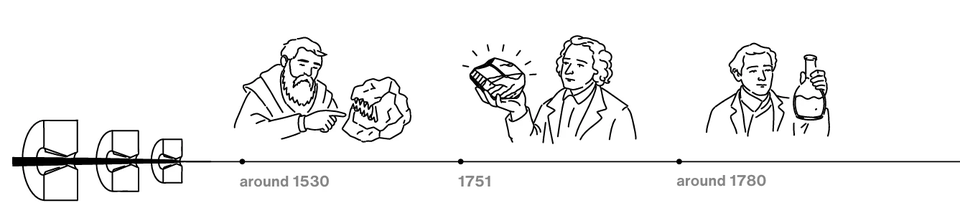
At first, tungsten was a major nuisance. Mining historians first reported in the mid-16th century about a mineral that caused problems in the mines. Tin ore laced with this element turned into slag during smelting, making it impossible to extract the tin. Like a wolf tearing apart a flock of sheep, this substance “devoured” the tin ore. The Saxon scholar Georgius Agricola, founder of modern mineralogy, described the mysterious mineral as “lupi spuma” – “wolf's spit.” In the mid-18th century in Sweden, mineralogist Axel Frederic Cronstedt searched for previously unknown rocks with his blowpipe. In a mine, he found a stone laced with a substance and noticed it was heavier than stones of the same size without the element. So he called it “tungsten” – “heavy stone.” He had stones with similar properties sent from Freiberg in Saxony, which has been home to a mining academy since 1765. These minerals were of the same type as those previously discovered by Georgius Agricola. Starting in 1780, German-Swedish chemist Carl Wil helm Scheele began researching this substance. He managed to extract an acid from the heavy stone: tungsten-syra. Two Spanish chemists continued the experiment, using carbon reduction to produce small metallic spheres from the acid. They called the isolated element “wolfram,” in reference to the name Agricola gave the substance. Soon, confusion began over the naming of the new element: In Germany, people initially tried to eternalize Carl Wilhelm Scheele, but the term “Scheelium” did not catch on. In English and French, the term “tungsten” remained. Ironically, the Swedes – whose language the word originated from – adopted, along with the Spanish and eventually the Germans, the name “wolfram.” There have been repeated attempts to standardize the designation worldwide. For a while, “wolfram” was considered the global name of the element, and its symbol in the periodic table is W. Currently, “tungsten” is the official designation again, but both names are still used.
A Light Comes On – The Race for the Best Filament Element
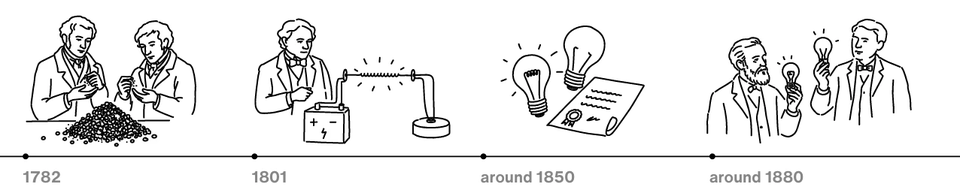
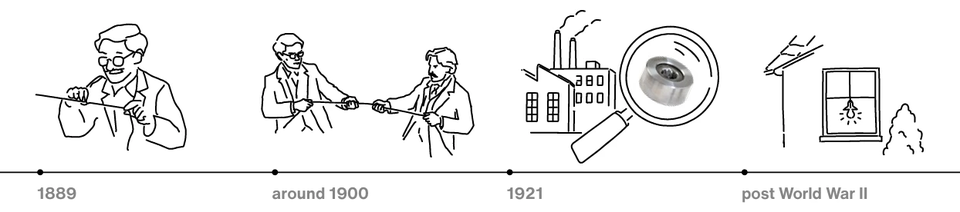
The phenomenon that certain wires glow when electric current is passed through them was already known at the start of the 19th century. The big question that occupied researchers worldwide throughout the century: What should such a filament and its environment look like so that an electric lamp burns as long as possible without the wire breaking or melting? Thomas Alva Edison is commonly considered the inventor of the light bulb, but English physicist Joseph Wilson Swan had already developed a workable model two years earlier, equipped with a carbon filament of high electrical resistance. Edison's achievement was to improve the technology and industrial scalability. He realized this was a potential mass product, and so, starting in the 1880s, with the introduction of the Edison lamp, the electrification of the world began. The lamp industry invested heavily in optimization, realizing that carbon filaments were not the final answer. Alternatives existed, especially osmium and tungsten, two metals with very high melting points that prevent the filaments from melting at temperatures up to 3,000 degrees Celsius (5,432 degrees Fahrenheit). Enter Carl Auer von Welsbach. The entrepreneur from Vienna was not only the discoverer of four chemical elements but also a man of brilliant ideas. He invented the gas light mantle (also known as “Auerlicht”) and the flint in lighters (“Auermetall”). In 1898, he developed the first metal filament lamp using osmium. Auer pulverized the element, formed it into a thread, carbonized it, and wound it into a filament. The result: the light was bright and white, and above all, the lamp lasted longer. Demand for electric lamps soared, and companies like Siemens, Philips, and General Electric dominated the market, along with Auer’s company. It was clear: the light bulb would be a unique success story. The problem: Osmium is rare and therefore expensive. A competition began on two fronts. First, who would secure the limited osmium deposits? Second, who would find an alternative to the rare and brittle osmium? It soon became clear that tungsten was the better candidate. It was more abundant and additionally easier to process. “Tungsten has an unmatched melting point of 3,422 de grees Celsius, or 6,192 degrees Fahrenheit,” says Uwe Schleinkofer, Director of R&D at CERATIZIT, a business area of the Plansee Group. “Tungsten is also brittle, but: under certain conditions it remains a malleable material. That means it can be processed industrially – a funda mental requirement for technical innovation.” Like many other researchers at the time, Carl Auer von Welsbach adapted his approach. He coated the carbon filament with tungsten powder and called the improved lamp “Osram” – a portmanteau of osmium (the idea’s inspiration) and tungsten (the optimal element). From 1919, the company he founded bore this name. Today, the Osram brand still reminds us of the brief time when osmium and tungsten competed for the best filament material.
The Alchemist at Lake Plansee – Paul Schwarzkopf and His Patents
Paul Schwarzkopf, born in Prague and educated in Berlin, was working at the Italian lamp factory Lampada Zeta when he developed a method to manufacture tungsten wire industrially. He used the technique of powder metallurgy: Tungsten ore becomes tungsten oxide, which is turned into powder. Heating this powder to up to 3,000 degrees Celsius (5,432 degrees Fahrenheit) yields a workpiece with tremendous density, hardness, and strength, but which still remains malleable. Powder metallurgy made tungsten manageable and industrially scalable. “Paul Schwarzkopf didn’t invent tungsten wire, but he was undoubtedly the pioneer of industrial production,” says Alexander Tautermann, Director of Marketing and Sales at Plansee HPM, also part of the Plansee Group. The alchemists of the Middle Ages tried to turn base metals into gold. Paul Schwarzkopf, the alchemist of the electric age, created a wire from “wolf’s spit” that illuminated the world. Back in Berlin, Schwarzkopf foresaw the tremendous global demand for filaments in the early 1920s. He also recognized the high energy demands during production and decided to locate industrial production of tungsten wire where energy was less expensive than in Berlin. He read in the newspaper about a new hydroelectric plant at Lake Plansee in Austria. He quickly founded Metallwerk Plansee GmbH in Reutte in 1921, the ancestor of today’s Plansee Group.
The world we live in wouldn’t exist without without hard metals. - Uwe Schleinkofer
Only Tungsten Conquers Tungsten – The Invention of the Drawing Die
Manufacturing the wire remained a technical challenge. Tungsten is extremely abrasive due to its hardness. It grinds down and wears out other materials, making this metal difficult to work and shape. Schwarzkopf’s idea: Only tungsten itself can handle tungsten. He developed the drawing die, which like the wire is made from tungsten processed in this application to carbide. This is still produced today by CERATIZIT. “You feed a wire that has too large a diameter into the smaller hole of the die and pull it through with tremendous force, so it comes out thinner at the end,” explains Uwe Schleinkofer about the principle of plastic deformation. Paul Schwarzkopf patented both the industrially manufacturable tungsten wire and the drawing die. “With these two innovations, he renewed the entire production process,” says Alexander Tautermann. Drawing dies are still in use today as an example of carbide tools – the expertise of CERATIZIT. For these, brittle hard materials like tungsten carbide are bonded with tough metals. The result: a compound that combines the positive properties of both – hardness and toughness. The impact of carbides on the world of technology is hard to overstate, adds Uwe Schleinkofer. “The world we live in wouldn’t exist without carbide. We wouldn’t be able to process metal efficiently enough to build cars, ships, or tunnels."
Suddenly Obsolete – As the Light Bulb Fades Out, Tungsten Wire May Vanish With It
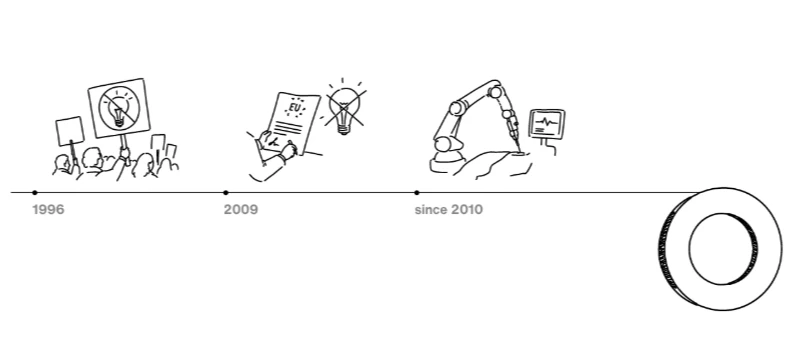
For decades, the worldwide hunger for tungsten wire was almost insatiable. The major lighting manufacturers long ago began producing their own filaments. “They’re the heart of every lamp. If the tungsten wire is good, the bulb is good. If not, then not. That’s why manufacturers took production into their own hands,” says Uwe Schleinkofer. Plansee HPM, specializing in the manufacturing of tungsten wire, discontinued production for light bulbs in the 1960s because the lighting industry no longer needed a supplier. For decades, the light bulb was a successful mass-produced item worldwide, illuminating millions of homes. Starting in the 2000s, it suddenly faced criticism – and was ultimately phased out. The reason: its poor energy efficiency. Only five percent of the electricity used is converted into light energy, the rest is wasted as heat. The use of new LED lamps saves up to 90 percent energy. That’s a compelling argument in times of the climate crisis. Australia was the first country to announce the end of the light bulb in 2007. Soon after, an EU directive stated that the conventional light bulb would also be phased out in Europe starting in 2009. Newspapers and magazines immediately published sentimental tributes to the lamp equipped with the tungsten wire. Süddeutsche Zeitung wrote: “The world is getting cooler.” Der Spiegel said goodbye with: “Wiry, hot, a superstar.” Kronen Zeitung kept it brief: “Burned out!” Deutschlandfunk even reported that enthusiasts were panic-buying hundreds of bulbs before they disappeared. Like the light bulb itself, tungsten wire became a “product that was no longer needed” starting in 2009, as Michael Mark, Head of R&D at Plansee HPM, put it. After decades of extreme demand, it became a commodity with massive overcapacity. But precisely this oversupply was an opportunity. Specialists in the companies began searching for alternative uses. “Their thinking was very pragmatic,” says Alexander Tautermann, “along the lines of: We have this surplus fine wire – where else could its diverse properties help?”
Risen from the Ruins – The Comeback of the Tungsten Wire
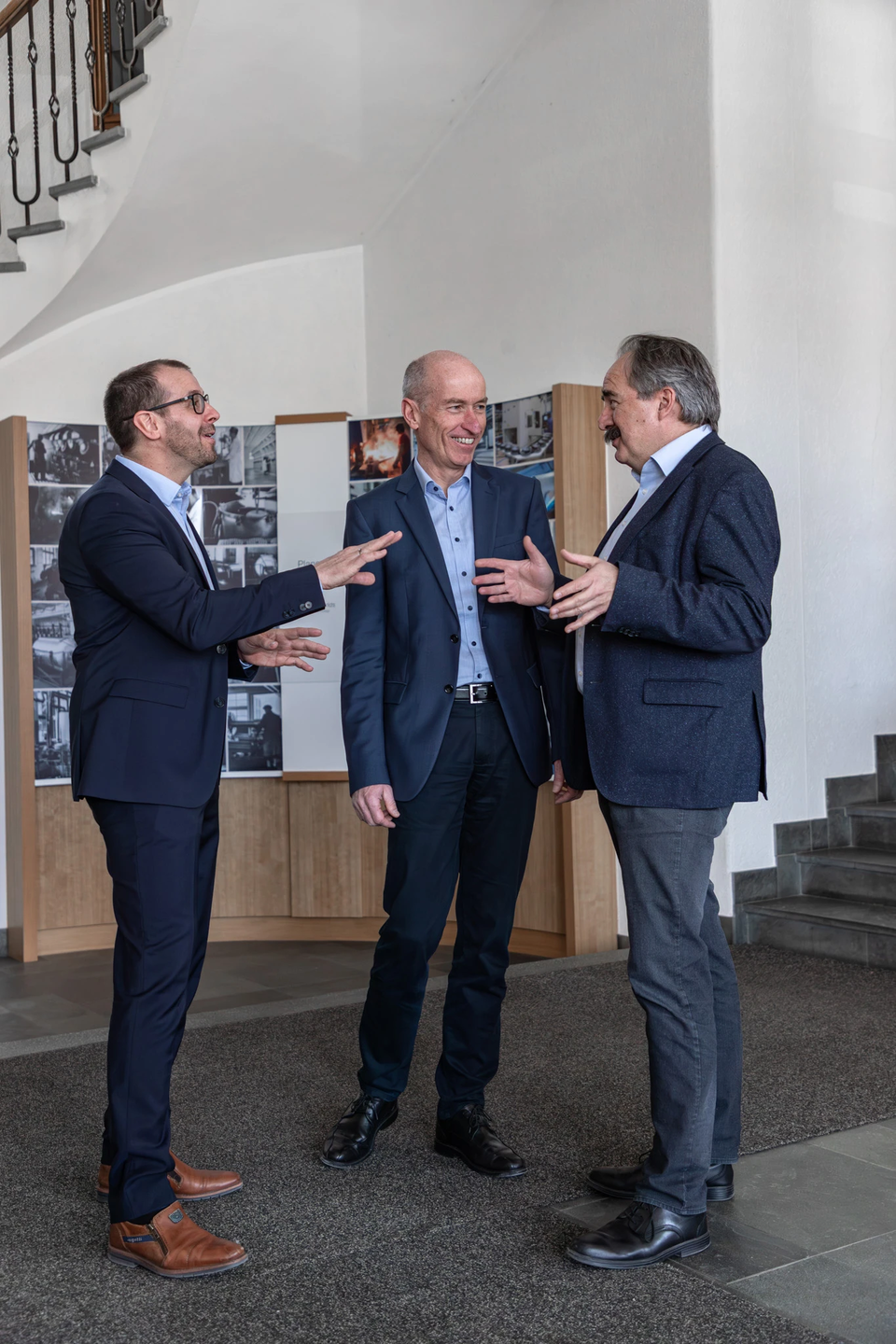
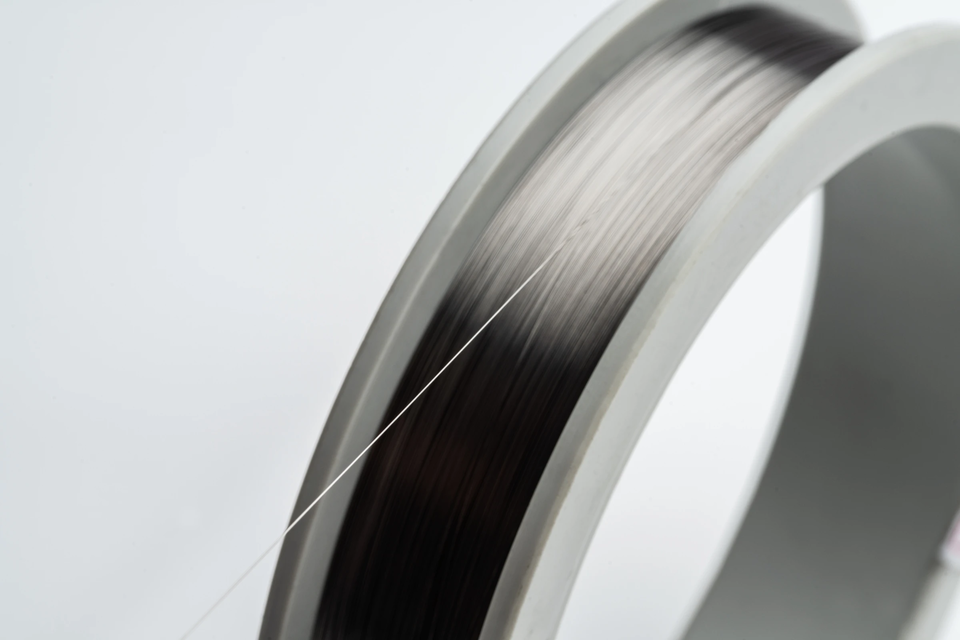
Overcapacity became a driver for innovation. Tungsten wire found a new use in modern digital medicine. Here, wires are needed that, despite minimal diameter, are absolutely resistant to breaking. That bend without losing their shape. And that are well tolerated by the human body. In all these aspects, ultrafine tungsten wire, with a minimal diameter of up to 0.01 millimeters, excels. “In medical robots, bundled tungsten wires are used for control during precise and minimally invasive procedures,” Michael Mark recounts as one example. Tungsten wires are also used as guidewires during catheter surgery. Used as the tips of surgical wire instruments, they help cut or ablate internal vessels with electrical impulses or high temperatures. Another distinguishing feature of tungsten is its immense stiffness. In materials science, this is referred to as a high modulus of elasticity. This value describes how much a material deforms elastically under mechanical tensile stress. Rubber has a very low modulus. Steel has a high one. Tungsten has the highest among metals, five times higher than gold. “That enables the mechanical precision required in modern medical technology,” says Uwe Schleinkofer. “Simply put: tungsten wire doesn’t wear out.” Fine tungsten wire also demonstrates its properties in automobile windshields. You won’t see it there – it would block the view. The glass contains ultra-fine embedded wires that function as heating elements wires to prevent fogging and ice formation. The fine wires are also used in shipping as protection against frost. Since tungsten wire is once again more of a specialty than a mass product, the market has changed again. Major lighting manufacturers have switched to LED lamps and stopped producing filaments. Production returned to specialty companies. Plansee HPM is once again one of them – and has a major advantage over the competition: It always has enough tungsten in stock. By far the largest tungsten deposits are in China, which supplies three-quarters of global demand. “Plansee HPM is the only tungsten wire manufacturer that is independent from China,” says Uwe Schleinkofer. How do they make it possible? “Almost 90 percent of the tungsten we use comes from recycling. It’s not an easy process, but we’ve mastered it.” Is there a possibility that tungsten wire, given its adventurous and eventful history, will someday be obsolete? “Unlikely” – all three experts agree. The material is simply too uniquely diverse.
Media contact
Dénes Széchényi
Head of Group Communications
Nr. +43-5672-600-2243
Mobile +43-664-81 52 598
denes.szechenyi@plansee-group.com
About the Plansee Group: Focus on Molybdenum and Tungsten
With its products, the Plansee Group enables applications at the cutting edge of what is technically and physically feasible – in electronics, medical technology, energy supply, mechanical engineering, the construction industry, mobility, and security and defense.
Headquartered in Reutte, Tyrol, the group specializes in the powder metallurgical processing of the high-performance materials molybdenum and tungsten. The value chain extends from the processing of scrap and ore concentrates through the manufacture of intermediate products and blanks to the development and production of customer-specific components and tools.
The Plansee Group, with its parent company Plansee Holding AG, unites two strong business areas:
· Plansee High-Performance Materials, specializing in metallic products made of molybdenum and tungsten.
· Ceratizit, focused on tools made of hard metal (tungsten carbide) for the trades, machining, and industrial manufacturing.
The Plansee Group ensures long-term security of supply for its key materials through recycling and long-term partnerships with mining operators. The Plansee Group holds a 31 percent stake in the Chilean molybdenum processor Molymet and a 10 percent stake in the tungsten mining operator Almonty.
With 11,120 employees at 36 production sites, the Plansee Group generated consolidated revenue of 2.35 billion euros in fiscal year 2025/26. The fiscal year ends on the last day of February.


