01. July 2026 News

On the Path to Energy Transformation

Nuclear Fusion

Nuclear fusion is considered one of humanity’s greatest dreams: nearly inexhaustible energy, much safer than nuclear fission. This principle has been operating in the sun for billions of years. Yet on Earth, under completely different conditions, researchers have reached the limits of what is physically and technically possible. Extreme temperatures, enormous forces, and materials that must permanently withstand these conditions pose tremendous challenges for this form of energy generation. What role does tungsten play in the process, how close is the research to practical implementation, and where do the hurdles still lie? This is a journey in six stages. The starting point is our sun.
 
 
1
 
Inside the Sun
 
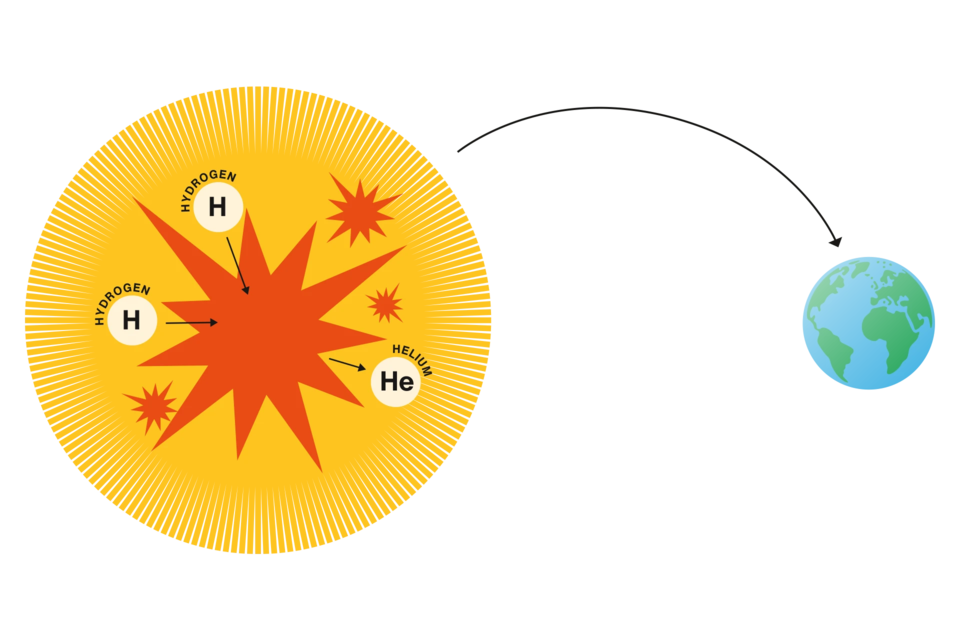
The sun is a gigantic power plant that generates enough energy for an entire planetary system. How it does this is now very well understood. There is always something happening inside the sun: hydrogen fuses into helium. This is highly unusual, since positively charged hydrogen nuclei normally repel each other. However, the enormous pressure, the temperature of 15 million Kelvin, and a quantum mechanical effect ensure that two colliding hydrogen nuclei eventually merge into a single helium nucleus in several steps. The total mass of the resulting helium nuclei is slightly less than that of the hydrogen nuclei; the resulting mass difference is converted into energy. You can still feel this energy some 93 million miles away when people, literally, recharge through sunlight exposure.
 
 
2
 
The Sun’s Method on Earth#
 
So what if we adapted the method from the sun’s interior for use here on Earth? Before we go any further, let’s take a step back: Isn’t it risky to use a second form of atomic energy alongside nuclear fission, as is utilized in nuclear power plants? “No, this form would be safe,” says Dr. Arno Plankensteiner, Director of Corporate Research at Plansee HPM, a business area of the Plansee Group. “Nuclear fusion does not produce uncontrollable chain reactions and only creates medium-level radioactive material, which has a much shorter half-life than the highly radioactive waste from fission.” “Would be,” said Arno Plankensteiner – in the subjunctive. Because after years of research, it’s clear: as ingenious as the idea is to bring the sun’s method to Earth, implementing it is difficult. “Physics is ready,” says the Plansee HPM expert. “But technology is hitting its limits.”
 
3
 
The Lightning Chamber
 
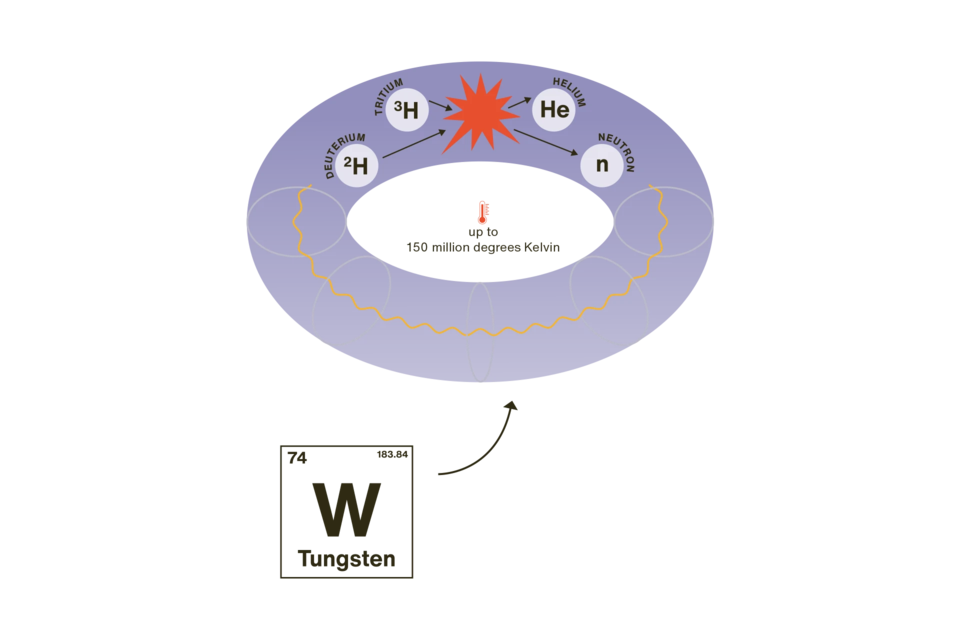
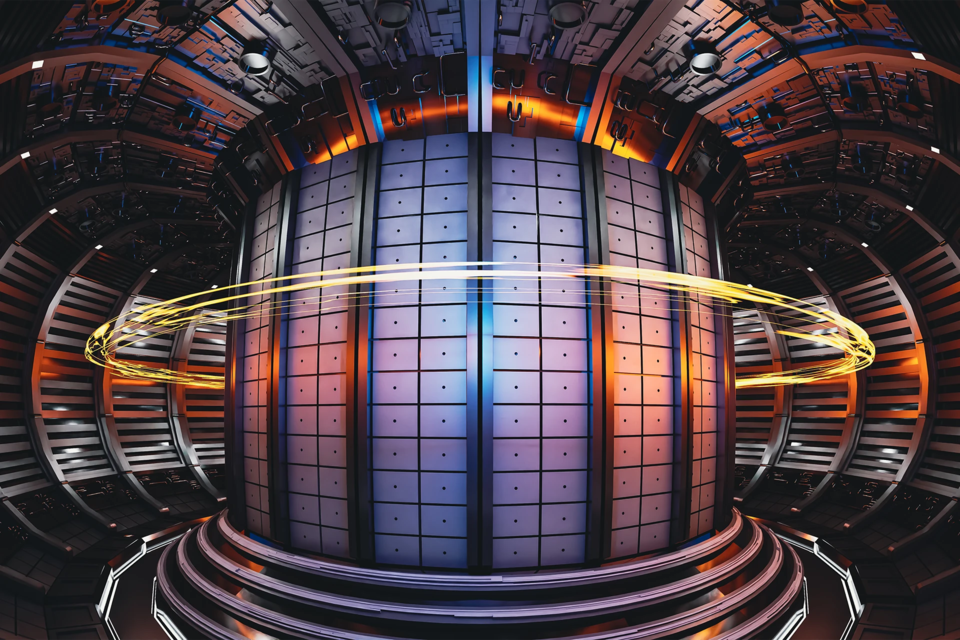
Instead of fusing hydrogen atoms like in the sun, on Earth it makes sense to fuse a few grams of a gas mixture made of the elements deuterium and tritium. The gas mixture is introduced into a giant, evacuated container shaped like a torus – imagine a giant donut or inner tube. There, the mixture is heated to up to 150 million Kelvin. At this temperature, electrons and atomic nuclei separate. This creates an electrically conductive plasma – a state of matter we all know from lightning during thunderstorms. Surrounding the torus-shaped plasma chamber are superconducting electromagnets that generate a very strong magnetic field. They ensure that the plasma is confined in the chamber and does not come in contact with the container walls. This is crucial, because even brief contact with the wall would immediately cool the plasma – and the process would collapse. The nucle ar reaction occurs when deuterium and tritium fuse to form helium. Neutrons are released, carrying enormous kinetic energy. This energy is converted into heat in the outer shell of the container, which in the next step is converted into electrical energy via a turbine. The entire process is highly complex and susceptible to disruptions. The current record, however, is impressive: In February 2025, the French research reactor WEST succeeded in keeping the plasma “burning,” as researchers call it, for a little more than 22 minutes. During this time, the interior of the container reached an almost unimaginable level of heat. “There are gigantic heat flows. We’re talking about 20 megawatts per square meter,” says Arno Planken steiner. What’s needed is a material that can act as the “first wall” and is able to absorb this energy and transfer it out of the container without sustaining damage. “That’s the design criterion,” says Plankensteiner. “This material must withstand stresses that don’t exist anywhere else in industry.” Also important: The material itself must not be toxic and must be available in sufficient quantity on Earth. For example, this is not the case with beryllium. “Which makes this promising candidate unsuitable,” Plankensteiner adds.
 
4
 
The Winner Is – Tungsten
 
Enter tungsten. It has the highest melting point of all met als: 6,192°F (3,422°C). It also has high thermal conductivity and shields against high-energy radiation, which is important because the material in the reactor is constant ly bombarded by neutrons. Since the early 1990s, Plansee HPM has been researching the use of tungsten as the material for the “first wall,” which is essentially a high-performance heat exchanger. A genuine business with a future. Except: When will this future become the present? Arno Plankensteiner tempers excessive enthusiasm, saying that it could still take several decades before the first commercial fusion reactor is built. There are more optimistic scenarios, but “since there are still many problems to be solved, which are all interrelated, it’s wise to have realistic expectations."
 

"Physics is ready."- Arno Plankensteiner


5

A Long-Term Goal

Nevertheless, the public sector is investing billions in nuclear fusion, and a growing number of private companies are getting involved in the research, development, and construction of fusion reactors – without making profits yet. Behind this is the realization that energy supply is one of the biggest challenges of the future, and nuclear fusion may be an answer. In October 2025, the German government decided to increase funding for fusion research, aiming for the world’s first commercial fusion reactor to be built in Germany. But even politicians know: Fusion is not a short-term solution. “Significant techno logical challenges still must be overcome on the path to the first fusion power plant,” the German government stated. It will take a joint effort by industry and science for this to succeed.

 

6
 
Incidental Discoveries
 
It’s common in research, while pursuing one goal, to discover insights that are also valuable elsewhere – what you might call “incidental discoveries.” For example, Plansee HPM gained valuable knowledge while developing heat exchangers capable of withstanding the heat flows from nuclear fusion. One such aspect is understanding how materials behave under extreme conditions. “These insights helped us not only develop heat exchanger components that withstand extremely high surface temperatures, but also determine material properties that we wouldn’t have identified without the demanding requirements of nuclear fusion. They’re now used in areas like medical technology,” says Plankensteiner. Besides tungsten, carbon fiber-reinforced graphite is also a material considered for the fusion reactor. What re searchers learn about its properties is used wherever it’s already commercially applied, such as in the brake discs of large aircraft or the rocket engines of Europe’s Ariane launch vehicles. Valuable “incidental discoveries” also result during the development of the technology needed outside the plasma vessel of the fusion reactor. “For example, we need energy technology, plant engineering, and measurement technology to convert the thermal energy from the fusion into steam and then into electricity,” says Arno Plankensteiner. Alongside major companies and research institutions, well-funded start-ups are becoming increasingly involved, bringing with them unconventional ideas and bold approaches. “This creates networks that, in turn, generate new knowledge – for example, measurement techniques for extreme conditions using sophisticated sensors to analyze and control the complex processes inside the plasma vessel,” says Plankensteiner.


Arno Plankensteiner is Director of Corporate Research at Plansee HPM in Reutte, Austria, and has been with the company since February 1998. He studied mechanical engineering at the Vienna University of Technology and received his doctorate there in numerical engineering methods and material mechanics.

About the Plansee Group: Focus on Molybdenum and Tungsten

With its products, the Plansee Group enables applications at the cutting edge of what is technically and physically feasible – in electronics, medical technology, energy supply, mechanical engineering, the construction industry, mobility, and security and defense.

Headquartered in Reutte, Tyrol, the group specializes in the powder metallurgical processing of the high-performance materials molybdenum and tungsten. The value chain extends from the processing of scrap and ore concentrates through the manufacture of intermediate products and blanks to the development and production of customer-specific components and tools.

The Plansee Group, with its parent company Plansee Holding AG, unites two strong business areas:
·    Plansee High-Performance Materials, specializing in metallic products made of molybdenum and tungsten.
·    Ceratizit, focused on tools made of hard metal (tungsten carbide) for the trades, machining, and industrial manufacturing.

The Plansee Group ensures long-term security of supply for its key materials through recycling and long-term partnerships with mining operators. The Plansee Group holds a 31 percent stake in the Chilean molybdenum processor Molymet and a 10 percent stake in the tungsten mining operator Almonty.

With 11,120 employees at 36 production sites, the Plansee Group generated consolidated revenue of 2.35 billion euros in fiscal year 2025/26. The fiscal year ends on the last day of February.

Media contact

Dénes Széchényi
Head of Group Communications
Nr. +43-5672-600-2243
Mobile +43-664-81 52 598
denes.szechenyi@plansee-group.com